
1. Introduction
Kenya’s Constitution guarantees free and compulsory basic education.. Since the introduction of Free Primary Education (FPE) and Free Day Secondary Education (FDSE), Kenya has achieved near-universal enrolment at basic education level. The Government has been granting capitation as the main financing mechanism. However, findings show that households bear the majority of education costs, effectively subsidising public education.
The Ministry of Education frequently explains that it does not possess statistics on the total cost of educating a child. This article demonstrates that while the Ministry may lack consolidated figures, credible estimates can be generated using existing capitation data and household expenditure patterns, particularly when distinguishing between day and boarding schooling.
Government Capitation: What the State Provides
Annual capitation per learner in public schools shows in primary (Grades 1–6) capitation is at KSh 1,420 per learner per year. In Junior Secondary (Grades 7–9) it provides KSh 15,042 per learner per year, while in senior Secondary (Grades 10–12) capitation is KSh 22,244 per learner per year
The total contribution by the Government for basic education (Grade 1–12) in primary (6 years) is KSh 8,520, junior school (3 years) is KSh 45,126 and senior school(3 years) is KSh 66,732
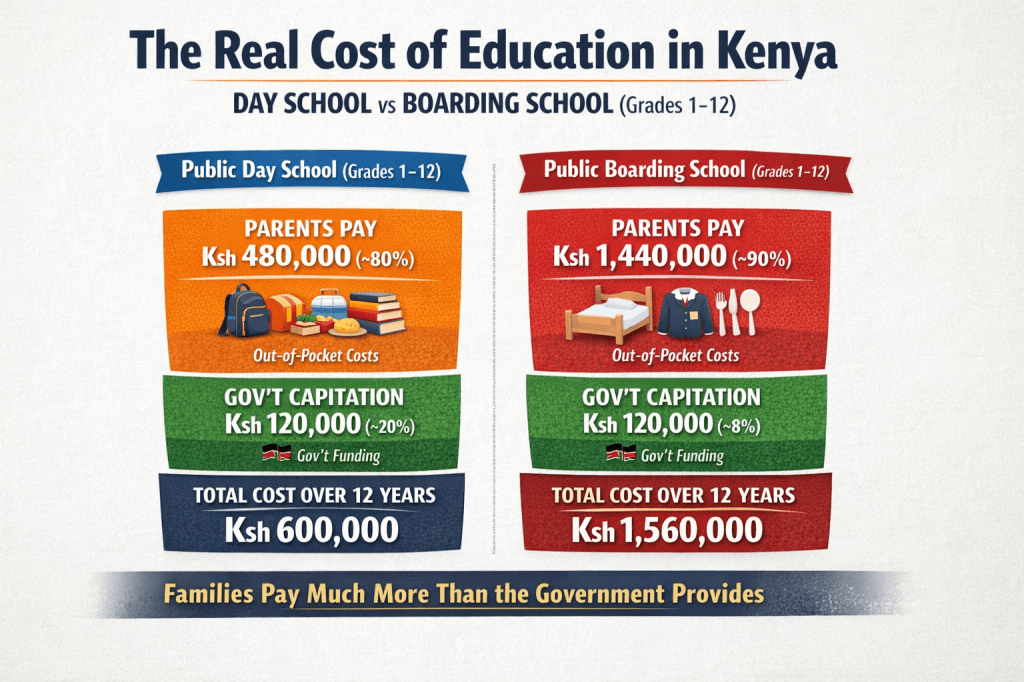
This translates to total government capitation over 12 years to KSh 120,000 per child. This amount covers school operations and tuition-related costs. It excludes household expenses such as uniforms, meals, transport, and boarding.
Estimated Cost of Education in Public Day Schools
The yypical annual household costs for day schools based on household surveys, school levies, and parental budgeting patterns show various indicators Uniforms & sportswear are estimated at KSh 5,000–10,000. Books & stationery cost KSh 5,000–10,000. Transport takes KSh 8,000–20,000. Lunch / meals require KSh 10,000–25,000, while activities & levies eat KSh 5,000–10,000. The average annual cost brings this utilities to KSh 40,000
So what’s the Total Cost of day Schools (Grade 1–12)?
Household contributes 40,000 × 12 = KSh 480,000, while the Government capitation takes KSh 120,000. This brings total real cost: to KSh 600,000. Given this figure household contribute 80% while government share is 20%.
This confirms that even in day schools, parents finance the majority of a child’s education.
What about Cost of Education in Public Boarding Schools?
Boarding schools introduce accommodation, meals, utilities, and supervision costs, significantly increasing household expenditure.
In public boarding schools the costs can be broken into:
• Boarding & accommodation: KSh 40,000–60,000
• Meals: KSh 25,000–40,000
• Uniforms & personal effects: KSh 10,000–15,000
• Books & stationery: KSh 8,000–12,000
• Transport & activities: KSh 10,000–20,000
This brings up an average annual boarding cost to KSh 120,000. For 12 years it amounts to Ksh 1, 440 000. High-end boarding education can cost more than 2.5 times day schooling, with households bearing over 90% of the total cost.
Why the Ministry of Education Says It Lacks Statistics
The Ministry’s claim is technically correct but substantively misleading. The reason is that MoE tracks enrolment and capitation, not household expenditure. On the other Kenya National Bureau of Statistics (KNBS) collects household cost data. This datais not integrated into MoE reporting. School-level levies are decentralised and not centrally digitised.
As a result, no single official document presents the full cost of education, even though the data needed to estimate it already exists within government systems.
Policy Implications of the Cost Gap
Due to lack of data, or refusal to consolidate data, households silently subsidise public education. This is because, although there has been an increase in capitation, it is difficult to justify government spending on education without consolidated data.
With the perceived gap in education funding Poor families face higher dropout risk, especially at boarding level.
Failure to quantify costs of education in Kenya by the ministry weakens evidence-based education financing. Free education messaging diverges from lived reality!
A Practical Way Forward
A national education cost framework can be achieved through:
• MoE–KNBS data collaboration
• Integration of school levies into NEMIS/KEMIS.
• Annual publication of day vs boarding cost ranges
• Disaggregation by region and school type
• Use of findings to inform capitation and social protection policies
8. Conclusion
Statistics on the cost of education in Kenya are not absent—they are fragmented. When consolidated, they show a clear reality: parents fund the largest share of public education, especially in boarding schools. Recognising this burden through official statistics is essential for transparency, equity, and constitutional fidelity.
Author’s note: All figures are conservative estimates based on government capitation rates, household expenditure patterns, and public school fee structures. Actual costs may vary by region and school.
References
• Ministry of Education (Kenya). Free Primary Education and Capitation Guidelines (various circulars).
• Ministry of Education (Kenya). Junior Secondary and Senior Secondary Capitation Policy Briefs.
• Kenya National Bureau of Statistics (KNBS). Kenya Integrated Household Budget Survey (KIHBS).
• Kenya National Bureau of Statistics (KNBS). Economic Survey (latest editions).
• World Bank. Public Education Expenditure Reviews – Kenya.
• UNICEF Kenya. Education Financing and Equity Reports.
• Parliamentary Budget Office (Kenya). Analysis of Education Sector Financing.
• UNESCO Institute for Statistics (UIS). Education Finance Indicators.
Dr. John Chegenye is a Human Resource Management scholar, educator, and consultant specializing in organizational behavior, labor relations, and performance management. He writes on leadership, labor policy, and institutional development.
 ChegzMad Consultancy
Leave a comment