

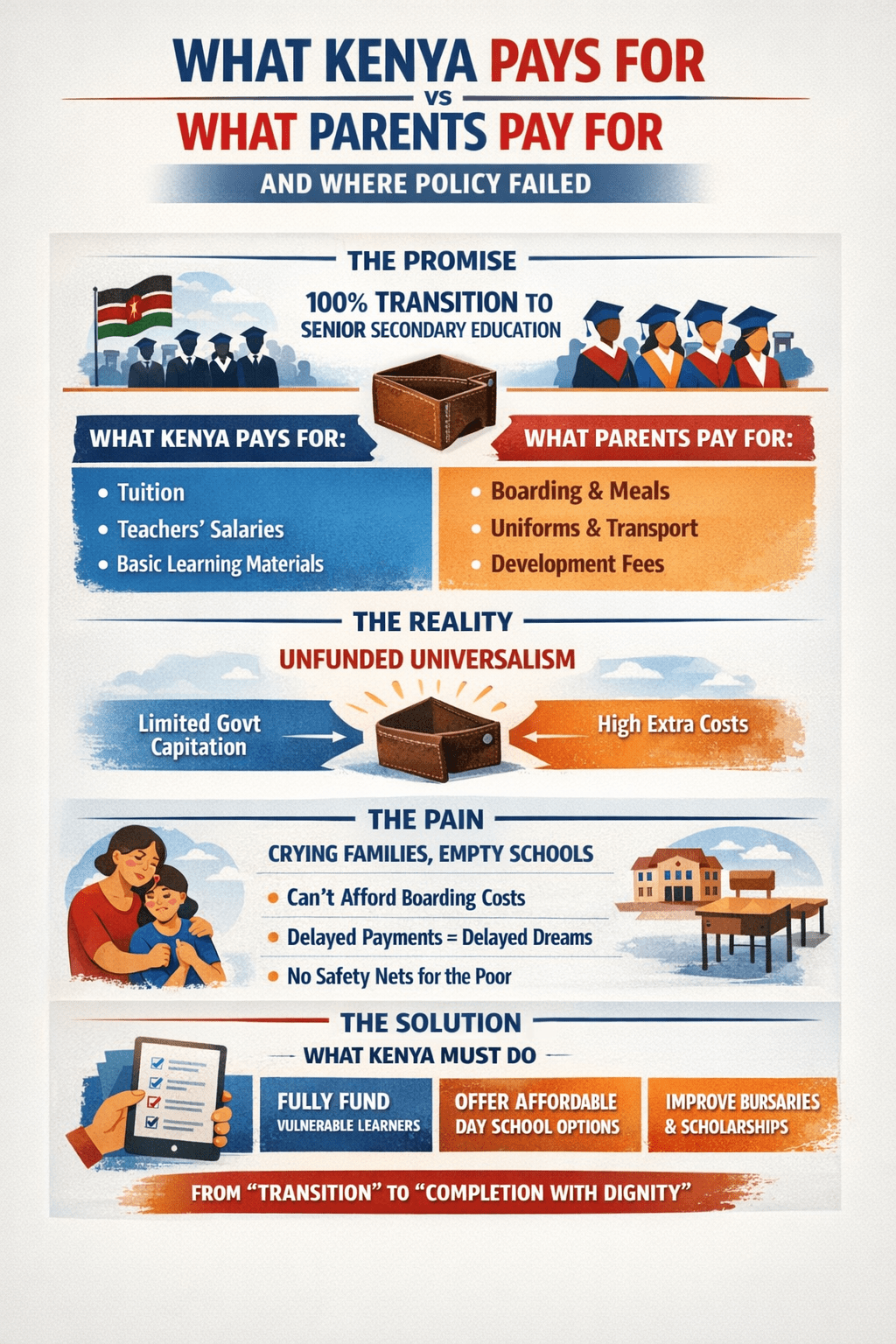
Across the country, a painful scene is repeating itself: parents in distress, children at home, and senior secondary schools reporting empty spaces. The question on everyone’s lips is simple but devastating — what is Kenya paying for as a country?
The honest answer is uncomfortable. Kenya is paying for access, not completion. For promises, not full delivery. And that gap between policy intent and lived reality is where today’s tears are coming from.
A Promise wthout full Financing
Kenya’s education policy proudly champions 100% transition from junior to senior secondary school. On paper, this looks like progress. In practice, it has become a classic case of unfunded universalism — expanding entitlement faster than the ability to finance it.
Government capitation halfway covers tuition and school operations. But it falls short on the real cost drivers of senior secondary education for parents: boarding, meals, uniforms, transport, and personal effects
What parents are experiencing is not free education — it is quiet cost-sharing, never clearly declared, never honestly designed for.
Where Policy went Wrong
1. Capitation Ignored Cost Reality
The government uses a flat capitation model which treats all schools and learners as equal, yet costs vary widely between boarding and day schools, urban and rural settings, and affluent and poor communities. The result is predictable: schools turn to parents to fill the gap.
2. Placement without affordability checks
Learners are placed without assessing whether families can realistically meet boarding and upkeep costs. This violates a basic policy principle: never impose a public obligation without checking the citizen’s capacity to comply.
3. Bursaries are treated as Charity
Bursaries and scholarships remain fragmented, politicized, and unreliable. They are handled as goodwill gestures rather than built into a national learner-financing system that automatically protects vulnerable students.
4. Weak Execution and late Disbursement
Even the limited funds promised for free education often arrive late. Schools then shift pressure to parents, parents delay payments, and learners delay reporting. The system collapses under its own inefficiency.
The Strategic Objectives Kenya Missed
This crisis is not just about money; it is about what the country chose to prioritize.
Enrollment Over Completion
Success was measured by transition statistics, not by whether learners could enter, stay, and complete senior secondary education with dignity.
Optics Over Affordability
Policy focused on announcing free education rather than designing education that the poorest households could actually afford.
One Expensive Pathway
Senior secondary education was treated as the default route, while affordable and equally respected alternatives such as TVET were underfunded and undervalued for along period.
No Built-In Safety Net
Support for orphans, informal-sector families, and marginalized regions was reactive instead of automatic. Vulnerability has been acknowledged rhetorically, but not structurally.
Failure to Question Cost Structures
The dominance of boarding schools — one of the most expensive education models — was never seriously re-examined, even as household incomes stagnated.
In the foregoing, education is not just a public service. It is hope, mobility, and dignity. When children are locked out of senior secondary education because of fees the state quietly shifts the burden of education to parents. This erodes trust in public policy.
If this situation remains unaddressed, this failure will repeat every year, increase dropouts, deepen inequality, and turn education from a ladder into a filter
What’s the way Forward?
Kenya must make clear choice to either fully fund senior secondary education, or openly declare cost-sharing and design strong protections for poor households
What the country cannot afford is silence — or pretending that a promise alone educates a child.
Until policy aligns with household economics, parents will keep crying, children will keep waiting at home, and schools will keep standing half-empty. And that is a national failure we can no longer explain away.
#EducationCrisisKE
#SeniorSecondary
#PolicyFailure
#FreeEducationMyth
#LetChildrenLearn
Dr. John Chegenye is a Human Resource Management scholar, educator, and consultant specializing in organizational behavior, labor relations, and performance management. He writes on leadership, labor policy, and institutional development.
 ChegzMad Consultancy
Leave a comment