

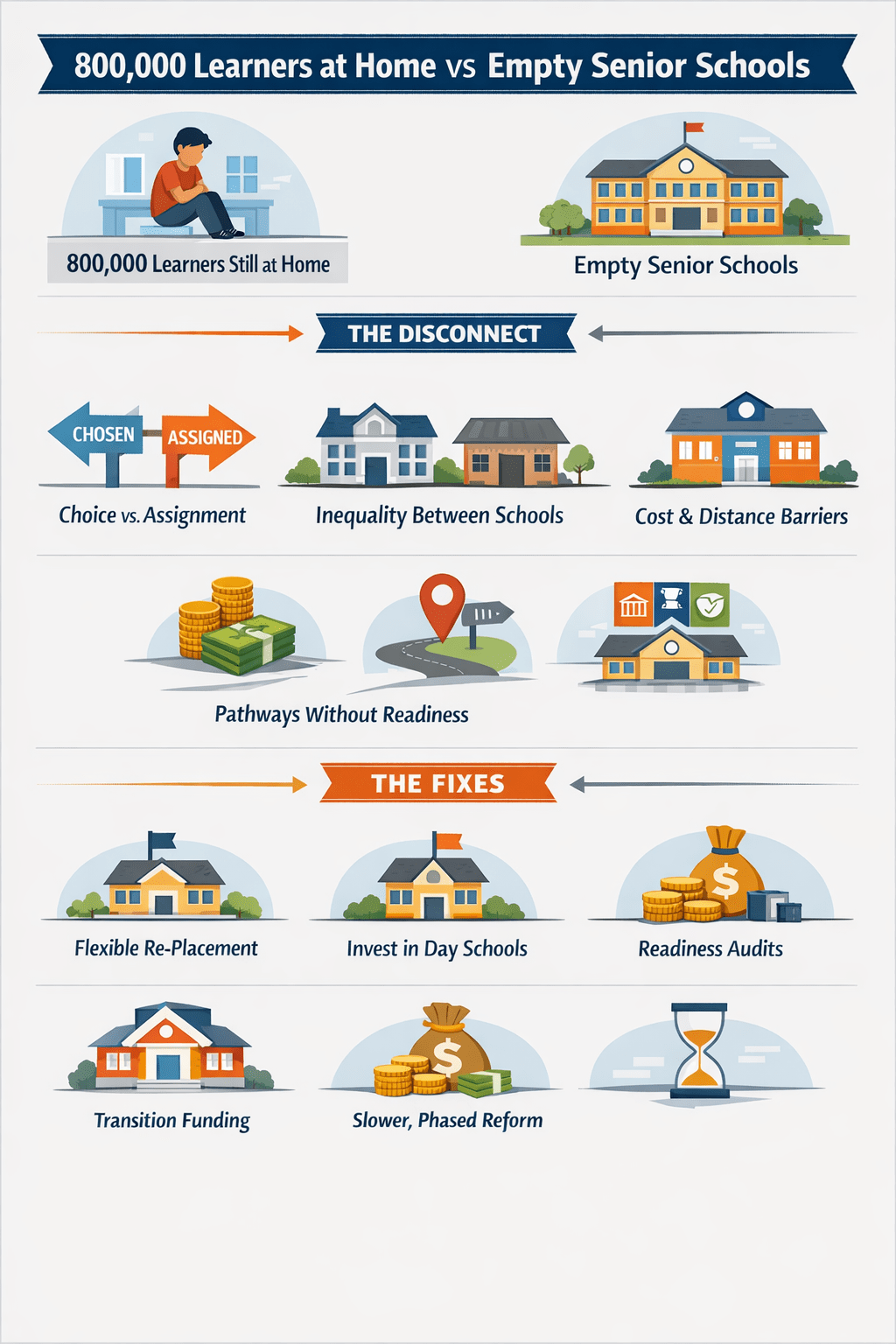
Kenya’s education system is facing a paradox that has unsettled parents, schools, and policymakers alike. It is reported that, by day three, about 800,000 learners have not reported to senior schools, yet thousands of senior schools remain under-enrolled or completely empty.
This is not simply a reporting problem. It is a system design and implementation failure at a critical transition point in the Competency-Based Curriculum (CBC).
How to we Fix this?
To fix this, we must first understand what went wrong, confront it, then move decisively toward practical, corrective reforms.
What we should have done Differently.
1. The rollout pace was too fast for social reality
CBC introduced multiple structural changes at once. These included:
• A new curriculum
• New assessment logic
• New pathways (STEM, Social Sciences, Arts & Sports)
• A new senior school placement system
• Reclassification of schools into senior schools
This was done without a phased transition that allowed families, teachers, and institutions to adapt gradually.
What should have happened
• Pilot senior school placement in selected counties first
• Allow at least one full cycle of learning and correction
• Scale nationally only after bottlenecks were identified and fixed
Instead, Kenya attempted a big-bang reform, overwhelming both systems and people.
2. Pathways were introduced before schools were truly ready.
• CBC implementation assumes that schools can offer distinct, well-resourced pathways. However in practice many “senior schools” lack labs, workshops, studios, or trained teachers.
• Some pathways exist on paper but not in reality. Parents have quickly sensed this gap and seem to lose confidence in the pathways
What should have happened
• Pathways should have been approved only after independent readiness audits
• Schools not ready should have remained junior schools temporarily
• Pathway expansion should have followed infrastructure investment, not preceded it
Labeling a school “senior” without capacity set the system up for rejection by parents.
3. The placement system ignored parental psychology
The Ministry of education has emphasized choice, but what families have experienced is extra assignment. When learners were placed far from home, in schools they did not select, and in pathways they did not fully understand, parents have reacted rationally by delaying reporting.
What should have happened
Parents expected:
• Fewer but more realistic school choices
• Strong weighting toward proximity, especially for day schools
• Transparent explanation of why a learner was placed where they were
The ministry policy underestimated one truth:
Parents will not cooperate with a system they do not trust.
4. Economic readiness was assumed, not supported
Comparatively, Senior schools are more expensive than junior secondary in terms of
Uniforms, Boarding-related costs, transport, and learning materials.
For many families, January comes with a lot of financial shocks.
What should have happened
• The government should have attempted targeted transition grants for vulnerable households
• Transport support for learners placed far from home
• Clear cap and enforcement on extra school charges
“Free education” without transition support is free in theory, not in practice.
5. Inequality between schools still exists
Placement in CBC system has assumed that all senior schools will be acceptable. This is not true. Parents still see:
• “Good schools” and “bad schools”
• Urban advantage vs rural neglect
• Boarding prestige vs day-school struggle
What should have happened
There is needed:
• Massive, visible investment in sub-county and day schools first
• Teacher redistribution before placement
• Public reporting on school readiness to build confidence
CBC could not erase decades of inequality overnight — and pretending otherwise was a mistake.
How we Can Fix This Mess The following are practical and quick fixes:
1. Immediately (next 6–12 months)
a) Allow flexible re-placement. Reopen placement windows without stigma. Priority be given to proximity and affordability. Let under-enrolled schools actively attract learners
b) Pause forced assignments or placement. No learner should be compelled into a school without basic pathway readiness. Create temporary holding arrangements in local day schools.
c) Emergency funding for vulnerable learners. Channel capitation early, introduce conditional transition bursaries, and work with counties to support transport and uniforms
2. Medium-term (1–3 years)
a) Re-audit senior schools
Independently verify pathway readiness, downgrade non-ready schools temporarily, and concentrate pathways regionally instead of spreading them.
b) Fix the information gap
Simplify pathway explanations, publish clear school profiles (facilities, teachers, costs), use chiefs, churches, and local forums for communications. Do not rely only 3digital platforms
c) Restore school-level agency.
Allow schools limited role in confirming placements, and enable structured dialogue between parents and schools before reporting ends.
3. Long-term reforms (structural)
a) Rebalance investment
Put serious money into day schools, make local schools genuinely attractive, and reduce the prestige gap between national and sub-county schools
b) Slow down future reforms
Umdertake no major curriculum or placement change without pilots. All reform should move at the speed of society — not policy papers
c) Align education with economic reality
Pathways established must link clearly to jobs, skills, and local economies
Otherwise, parents will continue to chase “traditional elite schools”
The Lesson for Kenya
The current crisis is not a rejection of education, nor of CBC itself. It is a reminder that:
• Education reform is as much social and economic as it is technical.
• You cannot digitize away poverty, rebrand inequality, or command trust by decree
• Parents are not resisting change, they are responding to risk.
Conclusion
The approximated 800,000 learners who are still at home and empty senior schools are not failures of families or children.
They are symptoms of over-speed reform, uneven readiness, and underestimated social realities
Kenya still has a chance to correct the course, but only if we shifts from defensiveness to design, from policy optimism to lived reality.
CBC does not need abandonment. It needs humility, adjustment, and patience.
#CBCKenya #EducationReform #EducationPolicy #PublicPolicy #KenyaEducation #SystemDesign #LeadershipMatters
Dr. John Chegenye is a Human Resource Management scholar, educator, and consultant specializing in organizational behavior, labor relations, and performance management. He writes on leadership, labor policy, and institutional development.
 ChegzMad Consultancy
Leave a comment