
The Kenya’s Grade 9 results have been released. The placement into Grade 10 is now happening. The release and placement is now generating widespread confusion and anxiety among parents and learners.
Reports indicate that learners are receiving wrong placements. There is unexpected pathway or schools. This unclear placement have fueled mistrust in the Competency-Based Curriculum (CBC).
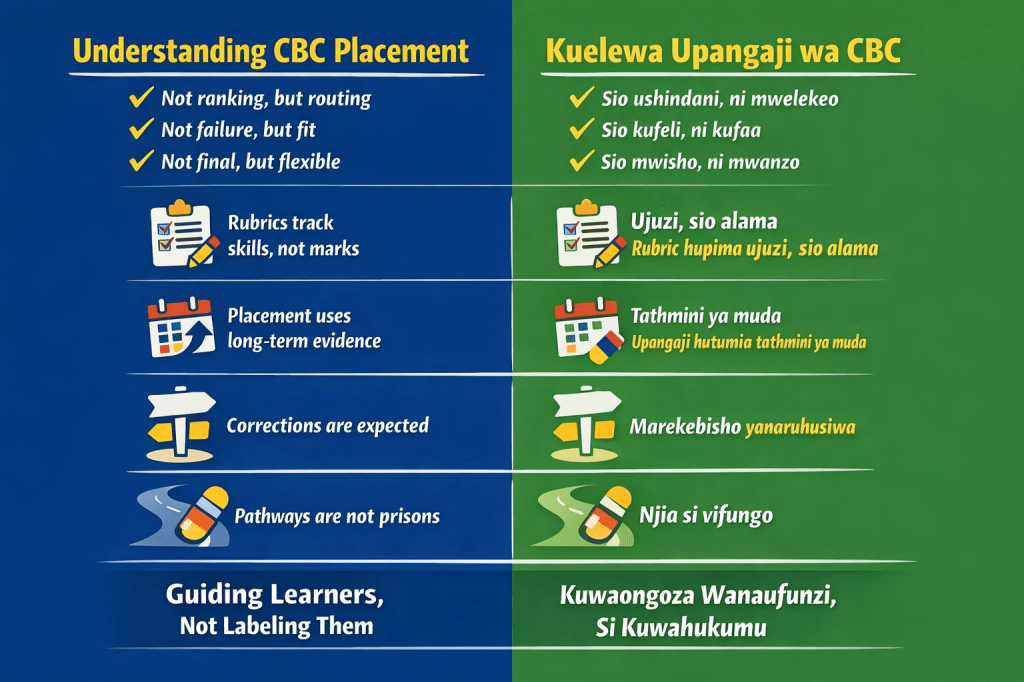
However, this moment should be understood. It is a transition stress point. The system is moving away from ranking toward skills-based pathways. We should not treat the unexpected placement of learners in pathways or schools as their failure.
Why confusion was inevitable
CBC represents a fundamental shift: it is moving our mindset from marks to competencies. From ranking to pathways,
From single exams to cumulative evidence. The biggest challenge is that communication has not kept pace with reform.
Many parents are still interpreting placement letters using KCPE/KCSE logic. In this logic a school name meant success or failure.
What really caused wrong placements?
Several challenges converged:
1. Assessment data gaps
Some schools submitted incomplete or inconsistent School-Based Assessment (SBA) records, forcing the system to auto-assign learners.
2. Learner identification mismatches
Errors in UPI linkage, transfers, or name records resulted in profiles being mixed or misread.
3. Uneven understanding of CBC rubrics
Teachers could have interpreted rubric levels differently, leading to distorted learner profiles.
4. Limited career guidance
Pathway choices were sometimes rushed, parent-driven, or treated as a formality.
5. Capacity constraints
Oversubscription in popular pathways (especially STEM) led to reallocation based on availability rather than preference.
6. Rigid algorithms in a first-time cohort
This being the first full CBC transition cohort, historical data was thin, making the system conservative.
What must be understood clearly
Placement under CBC is predictive, not permanent. The system expects:
• Early review
• Flexibility
• Corrections without stigma
The Way Forward
• Parents must seek understanding before reacting
• Schools must guide, not defend
• Government must communicate, correct, and reassure
If handled well, this transition will strengthen—not weaken—Kenya’s education reform.
PARENT APPEAL GUIDE
What To Do If Your Child Has the Wrong Placement
Step 1: Pause before acting
A placement letter is not a final judgment. Avoid rushing into transfers or public complaints.
Step 2: Report through the school
All appeals must begin at the learner’s current or former school.
Ask for:
• The learner’s CBC profile used for placement
• The pathway justification
• Assessment records submitted
Step 3: Identify valid appeal reasons
Appeals are strongest when based on:
• Clear mismatch between learner strengths and pathway
• Documented SBA errors
• Missing or incorrect learner data
• Medical or special learning considerations
Let’s not base appeals on, “We wanted a national school.” This is not a valid appeal reason.
Step 4: Submit within timelines
Appeals are time-bound. Late appeals risk rejection regardless of merit. The appeals start on 23rd December and end on 6th January.
Step 5: Support the learner emotionally
Reassure the child:
Let’s support children who may be feeling dissolutioned. Let’s encourage them that this is an adjustment, not a failure.
Understanding the CBC Rubric
A rubric is what is used to score learners for different levels. It a clear checklist showing what a learner can do, not how many marks they scored.
Think of it like a growth chart. Just as height shows growth over time, a rubric shows learning progress.
Rubric Levels Explained.
Beginning– the child is still learning. They needs a lot of support
Approaching- the child understands some parts. They are not consistent in doing what needs to be done.
Meeting Expectations- the child can do what is expected well independently. They don’t need support.
Exceeding Expectations – the child can Do what is expected very well and can support others who can’t do it.
What teachers actually observe
• Can the learner explain ideas?
• Can they apply knowledge?
• Can they work independently?
• Can they improve with feedback?
Conclusion
Our mindset must shift. Kenya has already adapted a new education system, the Competency-Based Education (CBE). This system has developed gradually through curriculum design and redesign of the Competency-Based Curriculum (CBC). We can’t imagine going backwards. A lot of investment has already happened. It’s the responsibility of all to understand the system and each one of us are expected to play their part.
#CBCKenya
#Grade9
#Grade10Placement
#ParentGuidance
#EducationReform
#CBCExplained
Dr. John Chegenye is a Human Resource Management scholar, educator, and consultant specializing in organizational behavior, labor relations, and performance management. He writes on leadership, labor policy, and institutional development.
You can also follow our YouTube Channel for related Videos @johnchegenye
 ChegzMad Consultancy
Leave a comment