

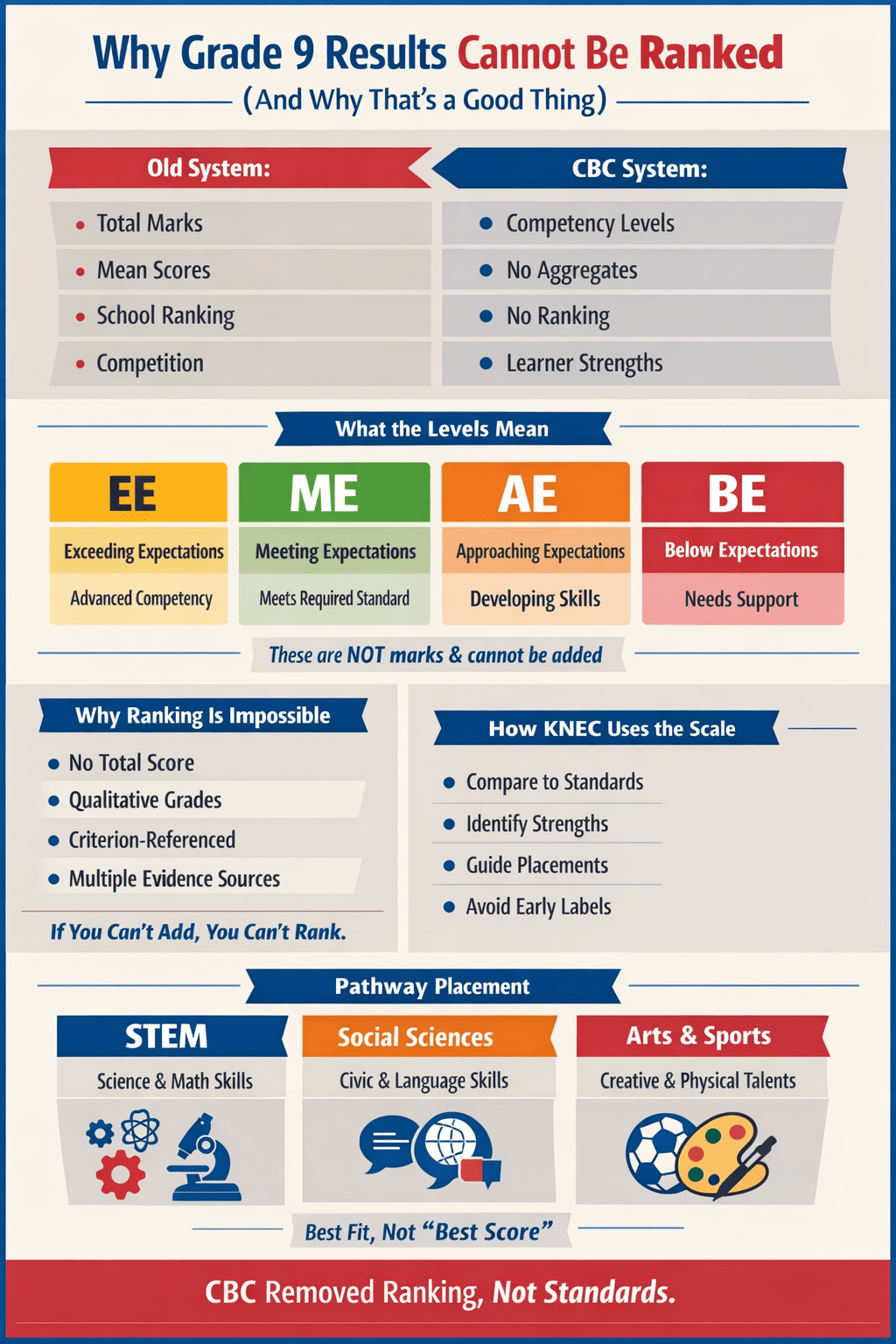

The release of Grade 9 results has triggered anxiety, confusion, and in some cases quiet panic among parents and schools accustomed to league tables and national rankings. Many are asking a familiar question in an unfamiliar system: “Where does my child stand?”
The honest answer under the Competency-Based Curriculum (CBC) is simple but unsettling: your child is not standing against others; they are standing against defined competencies.
This shift is deliberate. It marks the end of education as a race for points and the beginning of education as evidence of ability. To understand this moment, we must unlearn ranking and relearn meaning.
The Meaning of the “Points” – In Eight Clear Ideas
Understand CBC through these eight points.
1. These are not exam points; they are placement signals
The eight-point scale (from BE to EE, subdivided) is not a scorecard. It is a standardised signal showing how well a learner has demonstrated required competencies in a subject. The scale allows comparison to expectations, not to other learners.
2. KNEC needed a common language for diverse evidence
CBC assessment comes from multiple sources: classroom work, projects, practicals, and national assessment.
KNEC uses the eight-point scale to translate diverse qualitative evidence into a common placement language—not to create competition.
3. Ranking was removed; placement still requires differentiation
While ranking was abolished, placement decisions must still be made. Senior school pathways (STEM, Social Sciences, Arts & Sports Science) have capacity limits and skill requirements.
The points exist only to support fair, evidence-based placement, not to publish winners and losers.
4. Pathways demand different strengths
A learner excelling in scientific inquiry should not compete numerically with one excelling in creative or social competencies.
The eight-point system allows KNEC to identify readiness for specific pathways without declaring one pathway superior to another.
5. The points are criterion-referenced, not competitive
In the old system, points meant “you beat others.”
In CBC, points mean “you have demonstrated this level of mastery.”
Ten learners can receive the same level without contradiction. That alone makes ranking logically impossible.
6. Placement requires thresholds, not totals
Senior school pathways require minimum competency thresholds, not aggregate scores.
For example, STEM placement looks for consistent evidence of analytical, mathematical, and scientific competencies—not a high overall total.
7. The system protects learners from early mislabelling
Ranking at age 14 permanently labels learners as “strong” or “weak.”
CBC placement points are designed to be developmental, allowing learners to grow, shift pathways, and improve without the stigma of early ranking.
8. The points serve the system, not school prestige
League tables served school branding more than learner development.
KNEC’s placement points serve national workforce planning, skills development, and individual learner fit—objectives ranking could never achieve.
Why This Feels Uncomfortable (But Necessary)
Schools that depended on ranking feel disoriented because competition was their language of success. Parents feel anxious because numbers once gave certainty, even when that certainty was misleading.
CBC replaces comfort with accuracy.
This is not confusion caused by poor results; it is discomfort caused by a new educational philosophy colliding with old expectations.
The Bottom Line
KNEC did not remove ranking by accident.
It removed it because ranking:
• Distorts learning priorities
• Punishes diverse talents
• Reduces education to arithmetic
The Grade 9 points exist only to guide placement, not to judge worth.
The right question is no longer “What position did my child get?”
It is:
“What can my child do well, and where will they thrive next?”
That is not the end of standards.
It is the beginning of meaningful education.
By Dr. John Chegenye; a Human Resource Management scholar, educator, and consultant specializing in organizational behavior, labor relations, and performance management. He writes on leadership, labor policy, and institutional development.

 ChegzMad Consultancy
Leave a comment