

Introduction
Electoral integrity in emerging democracies often hinges on mitigating fraud. Fraud is usually perpetuated by ballot stuffing—the illegal insertion of extra ballots and other related activities. Ballot stuffing is a historical and persistent threat to free and fair elections
Following controversial past elections, East African nations like Kenya and Tanzania have introduced new safeguards. The Kenya’s multi-layered approach, involving the Kenya Integrated Election Management System (KIEMS) and extensive human oversight, has tried to address the challenge of ballot stuffing. Let me try to unpack this approach.
1. The Technological Firewall and Its Limits
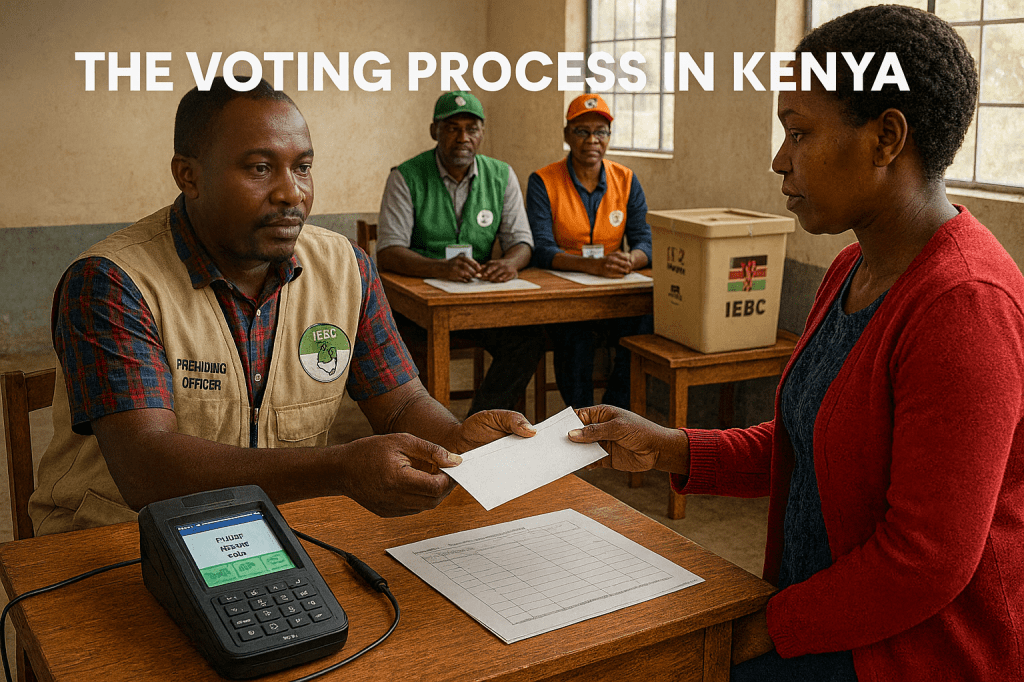
Kenya’s Independent Electoral and Boundaries Commission (IEBC) utilizes the KIEMS, which is a structural mechanism designed to enforce the principle of “one person, one vote” and limit the potential for fraudulent ballot issuance.
The Barrier to Impersonation (Electronic Identification)
The core function preventing ballot stuffing via repeat voting is the Electronic Voter Identification (EVID) system, integrated into KIEMS. On polling day, a voter must be authenticated—usually through fingerprints or facial recognition—against the secure Biometric Voter Registration (BVR) database.
This process ensures that:
• Verification: Only genuinely registered voters can be identified.
• Tracking: Once identified, the system records the voter as having cast their ballot, preventing them from voting again at the same or another polling station.
By neutralizing mass impersonation, KIEMS significantly limits one of the most common avenues for ballot stuffing.
2. The Vulnerability in the Manual Ballot Interface
Crucially, while identification is electronic, the actual casting of the vote uses traditional paper ballots. This creates a critical intersection where fraud can still occur
Strict Ballot Accountability where the IEBC issues a controlled number of ballots, exactly the number corresponding to the registered voters at that station makes it difficult to introduce extra ballots and mitigates ballot stuffing.
However, in cases where KIEMS kit fails to identify a voter, electoral law provides a fallback to manual identification using printed registers. This manual loophole, if abused or improperly managed, opens the door for officials to issue unauthorized ballots, allowing for fraud that bypasses the electronic count. To avoid abuse of this legal requirement the IEBC has established a human firewall!
The Human Firewall, Oversight and Accountability
Since KIEMS does not cover the final act of counting the paper ballots, a human firewall has been deployed to provide accountability and transparency. This involves political agents, observers, and IEBC’s temporary staff.
The Role of Agents and Observers
• Political Party/Candidate Agents: These individuals are the competitors’ partisan eyes inside the polling station. Their role is a frontline deterrence against stuffing. Agents:
• Monitor the issuance of ballots against the electronic and manual count.
• Crucially, they monitor the physical counting and reconciliation of cast ballots versus registered voters.
• Their refusal to sign the final statutory results form (Form 34A) serves as official documentation of a dispute, which is vital in subsequent legal challenges.
• Domestic and International Observers: These neutral missions provide impartial scrutiny. Their presence deters overt malpractice by IEBC staff and enhances the perceived legitimacy of the process by assessing whether procedures, such as showing the empty ballot box, have been followed.
The HR Management and Corruption Challenge
The effectiveness of the human firewall is directly exposed to issues of human resources management and corruption, which become the ultimate pathway for successful ballot stuffing.
Human Resource Weaknesses
The IEBC relies on recruiting and training tens of thousands of temporary personnel (Presiding Officers and Clerks), which presents two key HR challenges:
• Training and Competency: Inadequate or rushed training can lead to procedural errors (e.g., mismanaging the manual register or incorrectly filling out Form 34A). These mistakes create ambiguity and loopholes that malicious actors can exploit to commit or justify fraudulent vote totals.
• Workload and Vulnerability: IEBC staff often face immense pressure, fatigue from long hours, and poor working conditions. This environment increases their vulnerability to corruption and compromise.
Corruption and the Collusion Pathway
The primary pathway for ballot stuffing in the post-KIEMS era is collusion between partisan political actors and IEBC officials.
The IEBC officials are vulnerable to being co-opted by a political candidates. If an official is compromised through bribery or partisanship, they can facilitate stuffing by:
• Falsely certifying the count on the Form 34A to inflate a candidate’s votes.
• Allowing the unauthorized introduction of ballots during the count, relying on the fact that the political agent has been bribed to sign the fraudulent form anyway.
The high-stakes electoral environment in Kenya fuels the incentive for corruption, where political money is used to buy silence or active participation from both IEBC staff and, sometimes, opposition party agents, thereby neutralizing the human firewall.
Recommendations for Complete Elimination of Ballot Stuffing
How do we get it right?
The core weakness that can lead to election irregularity is the manual count and the vulnerability of temporary personnel. Complete elimination of ballot stuffing requires a dual-pronged approach focused on automation of the final tally and professionalizing the human element. This can involve:
A. Technological Tightening through Automating the Count
To eliminate the manual manipulation of the count (Form 34A), technology must be used to generate the result automatically:
• Mandatory Ballot Scanning at Polling Station
IEBC need to introduce a low-cost, secure scanner within the KIEMS kit, or as a standalone device, that scans the paper ballots immediately after the count is completed but before the Presiding Officer fills the Form 34A. This system should be designed for Optical Mark Recognition (OMR). The system automatically tabulates the result and prints the Form 34A. This eliminates transcription errors. The digital image of every single ballot is transmitted alongside the result form image.
• Zero Tolerance for Form 34A Discrepancies
The electronic tally of votes identified by EVID, the scanned count, and the handwritten Form 34A figures must perfectly reconcile. Any discrepancy above a tiny, fixed error margin (e.g., 0.5%) triggers an immediate, mandatory recount at the polling station, supervised by county-level IEBC officials.
HR and Logistics Reform
To completely seal the collusion pathway, corruption risks, which are inherent in temporary hiring, and logistics, must be minimized. How?
• Professionalization of Presiding Officers (POs): The PO role is too critical to rely solely on short-term contracts. Create a permanent or semi-permanent pool of highly trained, well-remunerated Certified Election Professionals (CEPs). This will reduce the vulnerability of POs to corruption, as their employment and professional reputation would be tied to integrity. This will address the Principal-Agent problem. Training must be extended to multiple weeks and include detailed scenario planning and ethics modules.
• Enhanced Ballot Box Custody and Tracking: Address logistics vulnerabilities between the polling station and the tallying center:
• Mandatory GPS Tracking: Every transport vehicle carrying sensitive materials must be equipped with IEBC-monitored, live GPS trackers.
• Dual-Key Custody Protocol: Implement a rigid, multi-party custody system for ballot boxes where the box seals are signed by the PO and at least two political party agents, with different parties holding keys to the transport bag or container. This makes solo manipulation during transit impossible.
• Auditing the Manual Back-up: Completely overhaul the manual identification process. Any polling station that uses the manual back-up (due to KIEMS failure) should be subject to a mandatory, prioritized audit of its paper trail (EVID register print-out and statutory forms) by an independent IEBC team immediately after election day. This discourages the deliberate sabotage of KIEMS kits to enable manual stuffing.
Conclusion
Ballot stuffing in Kenya, in the context of the KIEMS electronic identification system, is primarily a challenge of human and institutional integrity, not technological failure. The EVID system strongly mitigates simple impersonation. However, the manual paper ballot, combined with the procedural and ethical weaknesses of the IEBC’s HR system, means that the potential for stuffing remains. This fraud pathway has shifted from individual repeat voting to systemic collusion—where compromised IEBC personnel and political agents cooperate to manipulate the count on the statutory result forms. Complete elimination of this threat requires transitioning to semi-electronic counting and reconciliation (OMR/scanning) while simultaneously professionalizing the core field leadership to eliminate the vulnerabilities associated with high-stakes, low-paid temporary staff.
Kenya possesses a significantly more advanced technological check at the identification stage and a more robust judicial recourse to challenge the outcomes, but the integrity of the count and tally relies on the willingness to implement these final, difficult structural reforms.
Citations and Sources
• [1] Al Jazeera. (2022). Kenya election latest updates: Millions vote for new president.
• [2] Brill. (2024). Application of Election Technology in Kenya and Tanzania: a Self-Locked Knot?
• [3] VOA Africa. (2022). Kenya’s Election Uses High-Tech “Checks”.
• [4] ResearchGate. (2021). BIOMETRIC VOTER REGISTRATION AND ELECTRONIC VOTER IDENTIFICATION SYSTEM ON CREDIBILITY OF THE ELECTORAL SYSTEM IN KENYA.
• [5] Faculty of Law, Mzumbe University. (2025). Electoral Justice System in East Africa: A Comparative Analysis of Kenya and Tanzania.
• [6] IEBC Kenya. (archived content). Electronic Voter Identification System (EVID).
• [7] ORPP. (2023). QUICK GUIDE – ORPP (On Election Agents).
• [8] ACE Electoral Knowledge Network. Election Agents’ Manual.
• [9] USIU-AFRICA Digital Repository. (2021). The impact of democratization process on state stability in Kenya.
• [10] International Journal of Social Sciences Management and Entrepreneurship. (2023). Strategic human resource practices and employee performance in the Office of the Registrar of Political Parties in Kenya.
Dr. John Chegenye; HR Scholar, Educator, and Research Consultant
 ChegzMad Consultancy
Leave a comment