

Introduction
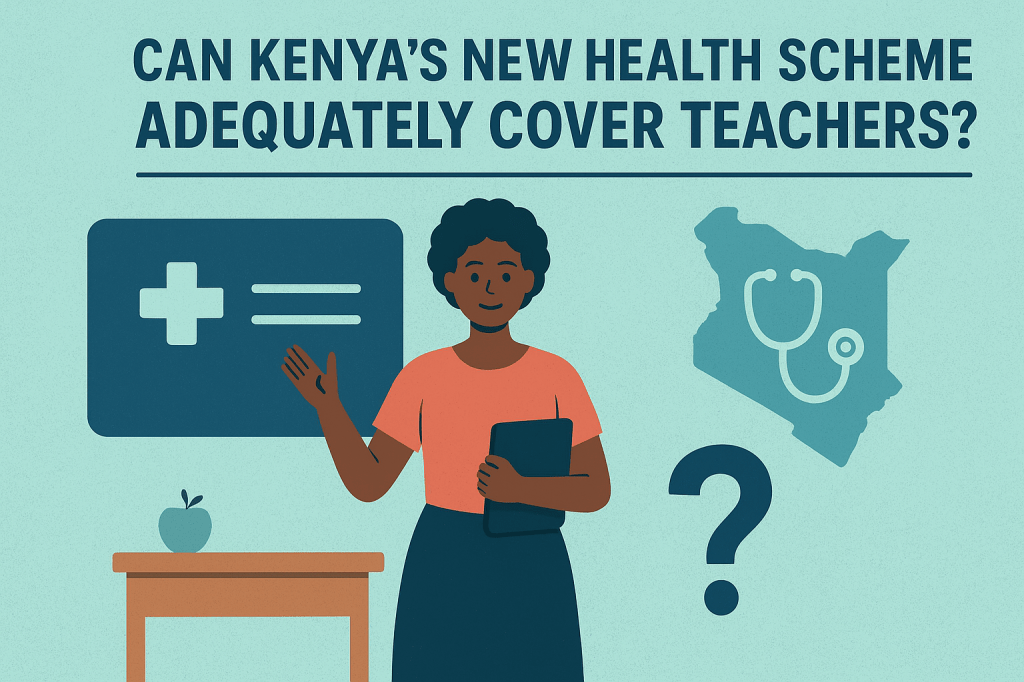
Kenya’s journey toward Universal Health Coverage (UHC) has taken a bold step forward with the establishment of the Social Health Authority (SHA) under the Social Health Insurance Act (2023). The new system replaces the National Hospital Insurance Fund (NHIF) with the aim of improving healthcare financing, equity, and efficiency. However, one critical question remains: Can the SHA adequately serve Kenya’s teachers—a large and vital workforce currently covered under the Minet (AON) medical scheme managed by the Teachers Service Commission (TSC)?
This article explores lessons from the transition from NHIF to SHA and evaluates whether this new national framework can meet the healthcare needs of teachers across the country.
From NHIF to SHA: The Promise of Reform
The new reforms in the health sector in Kenya intended to overhaul the health financing model by introducing three new funds under the SHA:
1. Primary Healthcare Fund – for community and basic healthcare.
2. Social Health Insurance Fund – for general medical coverage.
3. Emergency, Chronic, and Critical Illness Fund – for severe or long-term health conditions.
These reforms aim to create a more inclusive, transparent, and digitized health insurance model that ensures no Kenyan is left behind.
In principle, this approach addresses longstanding weaknesses in NHIF such as:
• Delayed provider payments,
• Limited access to quality healthcare,
• Corruption and inefficiencies, and
• Inequitable benefit distribution.
As unexpected, however, implementation challenges have already emerged. These are around institutional readiness, trust, and stakeholder coordination.
Lessons from the NHIF–SHA Transition
The aim of SHA was to leverage lessons learned in implementation of NHIF. These lessons were;
1. Readiness and Phased Implementation
The transition was perceived as rushed. Systems, staff structures, and ICT platforms were not fully ready, underscoring the importance of gradual rollout and testing before nationwide implementation.
2. Trust and Transparency
Historical inefficiencies at NHIF have eroded public confidence. SHA must prioritize transparency in operations, prompt claims processing, and open communication to win trust.
3. Provider Engagement
Many hospitals remain hesitant to contract with SHA due to unsettled NHIF debts and unclear reimbursement mechanisms. Sustained engagement and timely payments are essential.
4. Equity and Access
True universal coverage must ensure equitable access to healthcare, particularly for low-income groups, rural populations, and large public-sector workforces like teachers.
5. Organizational Culture Change
Replacing NHIF with SHA is not enough. Success depends on transforming institutional culture—emphasizing service, accountability, and performance.
The Teachers’ Experience: Minet vs. SHA
Kenya’s teachers, numbering over 350,000, are currently covered under the Minet (AON) scheme, which provides structured benefits to teachers and their dependents. This includes outpatient, inpatient, maternity, dental, and optical services.
• The Minet model offers:
• Dedicated service desks and helplines,
• Clear benefit limits,
• Wide hospital networks, and
• Predictable funding through the TSC.
In contrast, SHA envisions a universal model that includes all Kenyans through mandatory contributions based on income. While this is more equitable, it raises questions about customization and capacity. Can a national fund handle a population as large and specialized as the teaching fraternity?
Can SHA Adequately Cover Teachers?
At this stage, SHA is not fully ready to replace the TSC-Minets scheme. Its systems, staff, and structures are still evolving, and there are unresolved issues around provider payments and benefit clarity.
Currenyly, Minet offers more stability, while SHA holds the promise of greater inclusivity and sustainability in the future. SHA can potentially offer a superior, universal, and sustainable model if it achieves:
• Seamless payroll integration with the TSC,
• Robust digital and claims systems,
• Timely reimbursements to facilities, and
• Consistent quality of service across all counties.
Teachers require a scheme that balances mass coverage with individual responsiveness. This is a challenge SHA must plan for carefully.
The Way Forward
In order to make SHA what it is intended consider:
1. Phased Transition: Continue the Minet scheme while SHA strengthens its capacity and proves reliable.
2. Stakeholder Consultation: Maintain dialogue between the Ministry of Health, TSC, KNUT, and KUPPET to align policies and protect teachers’ welfare.
3. Performance Benchmarking: Use Minet’s service delivery standards as a benchmark for SHA’s performance.
4. Communication and Transparency: Teachers should be clearly informed about contributions, benefits, and access procedures under SHA.
Conclusion
The creation of the Social Health Authority marks an important step toward a fairer and more inclusive health system in Kenya. Yet, successful reform depends not only on policy but on governance, service quality, and public trust.
For Kenya’s teachers, the transition from Minet to SHA will only be meaningful if the new system can match or exceed the reliability, responsiveness, and quality they currently enjoy.
In the long run, Kenya’s goal should be clear: to build a national health insurance model that serves every citizen—teacher or otherwise—with dignity, efficiency, and equity.

Dr. John Chegenye, Ph.D.
Educator, Researcher, and Human Resource Management Specialist
#Universal Health Coverage Kenya
#Social Health Authority,
#NHIF, SHIF
#Teachers Service Commission,
#Minet, Healthcare Reform
#Kenya Health Policy
 ChegzMad Consultancy
Leave a comment