

Connecting Thought to Practice in Human Resource Research
Introduction
Human Resource (HR) research serves as the foundation for understanding workforce behavior, improving organizational effectiveness, and shaping strategic management decisions.
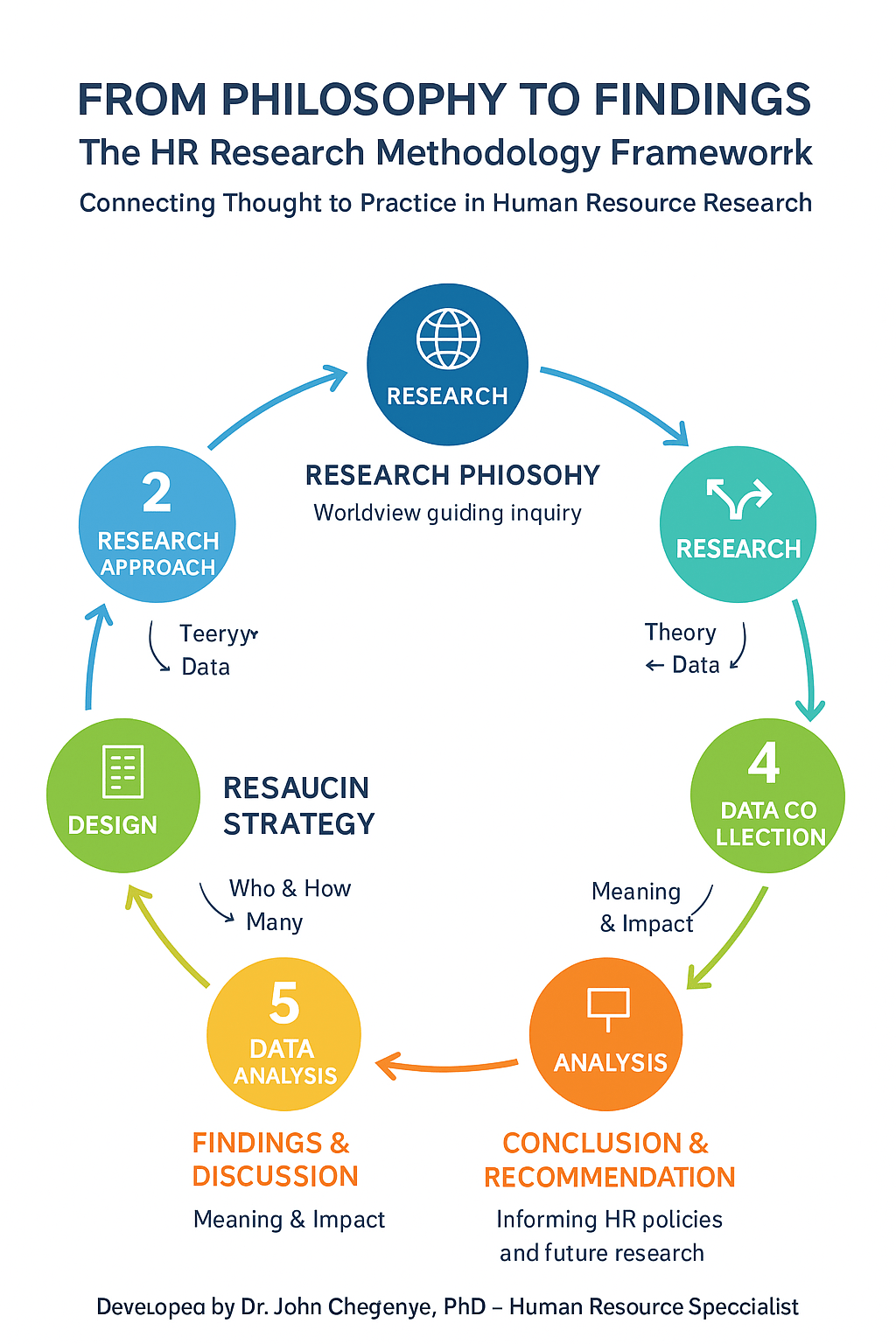
The HR research process is not a random sequence of activities; it follows a structured flow from philosophical assumptions to practical recommendations.
This framework—’From Philosophy to Findings’—illustrates how each stage of research builds on the previous one to ensure logical coherence, methodological rigor, and practical relevance.
Research Philosophy
Every research project begins with a guiding worldview or philosophy, which defines how knowledge is understood and interpreted. In HR research, the philosophy shapes the entire study—from the nature of questions asked to the interpretation of findings.
For instance, Positivism emphasizes measurable, objective data (e.g., studying performance metrics).
Interpretivism focuses on subjective experiences (e.g., understanding employee motivation).
Pragmatism blends both, allowing the researcher to choose methods that best address the problem.
Philosophy is therefore the foundation that aligns the researcher’s worldview with their methods and objectives.
Research Approach
Once the philosophy is defined, the next step is the approach. This is the reasoning process that connects theory and data.
For example Deductive approaches begin with theory and test hypotheses using data.
Inductive approaches derive theories from observed data patterns.
Specifically, an HR researcher may use a deductive approach to test Herzberg’s motivation theory in a workplace setting or an inductive approach to explore emerging leadership behaviors among managers.
Research Design
The research design acts as the blueprint of the study. It outlines how the investigation will be structured to achieve its objectives. Common HR research designs include:
1. Descriptive designs (e.g., exploring employee satisfaction trends)
2. Explanatory designs (e.g., examining relationships between training and productivity)
3. Case study designs (e.g., analyzing HR practices within one organization)
A strong design ensures that data collection and analysis are both valid and reliable.
Data Collection
Data collection is the stage where plans become action. HR researchers gather evidence using tools such as surveys, interviews, focus groups, or observation. The goal is to collect accurate and relevant information from employees, managers, or organizational records. For example, surveys can measure job satisfaction, while interviews can explore employee engagement experiences.
Sampling Strategy
The sampling strategy defines who participates in the study and how they are selected. HR research may use:
1. Probability sampling for generalizable results, or
2. Non-probability sampling for in-depth case insights.
Selecting the right participants ensures the findings reflect the broader organizational or population context.
Data Analysis
After data collection, the researcher moves to analysis, transforming raw data into meaningful insights.
– Quantitative analysis uses tools like SPSS or R to test relationships between variables.
– Qualitative analysis uses thematic or content analysis to interpret meaning from narratives.
In HR research, this may involve identifying statistical links between leadership styles and employee performance or deriving themes about workplace fairness.
Findings and Discussion
This stage interprets the analyzed data and links it to existing literature and HR theory. The discussion contextualizes the findings—explaining not just what was found, but why it matters. For instance, if results show that fair treatment improves employee commitment, the discussion links this to theories of organizational justice and workplace motivation.
Conclusion and Recommendations
The final stage converts research findings into actionable insights. HR researchers draw conclusions that summarize key results and make recommendations for policy, practice, and further research. For example, a study on performance appraisal fairness may lead to policy suggestions that improve transparency and employee satisfaction.
Connecting the Circle
The HR research process is cyclical, not linear. Each study’s conclusions inform new research questions and may even challenge existing philosophical assumptions. This continuous feedback loop ensures that HR research remains dynamic, evolving, and responsive to changing organizational realities.
Conclusion
This article demonstrates, from “Philosophy to Findings’ that HR research is a disciplined journey. It starts from abstract thoughts to practical applications. By following each stage systematically, researchers can produce insights that not only advance academic knowledge but also enhance human capital management in real-world organizations. In essence, effective HR research connects thought to practice, ensuring that theory guides action and evidence shapes policy.
The Author is Dr. John Chegenye, PhD – Human Resource Management & Development Specialist
 ChegzMad Consultancy
Leave a comment