

1. Introduction
In academic inquiry, particularly within Human Resource Management (HRM), understanding the interplay between research philosophy and research design is critical. Research philosophy defines the worldview and assumptions that guide a researcher’s approach to reality and knowledge.
Research design on the other hand translates these assumptions into a concrete plan for investigation. The coherence between the two ensures that HR research is both theoretically grounded and methodologically sound.
2. Research Philosophy
Research philosophy refers to the underlying set of beliefs that shape how a researcher perceives the world and the nature of knowledge. It is informed by ontological (nature of reality) and epistemological (nature of knowledge) assumptions. The major philosophical paradigms include:
• Positivism: Asserts that reality is objective and measurable. Positivists use quantitative data and statistical analysis to test hypotheses. Example: studying the relationship between training and employee productivity.
• Interpretivism: Views reality as subjective and socially constructed. Researchers focus on qualitative data to understand meaning and context. Example: exploring employees’ experiences of workplace change.
• Realism: Recognizes an independent reality but accepts that it can be imperfectly perceived. This approach often blends quantitative and qualitative techniques.
• Pragmatism: Focuses on practical outcomes and allows flexibility in method choice. Pragmatists use whichever approach best solves the research problem.
Each philosophy informs the research approach and determines whether a study will adopt a quantitative, qualitative, or mixed-method design.
3. Research Design
Research design serves as the blueprint for conducting research. It provides the logical structure that connects research questions to data collection and analysis procedures.
A. Quantitative Designs
• Descriptive: Describes characteristics of a population (e.g., employee satisfaction surveys).
• Correlational: Examines relationships between variables (e.g., motivation and job performance).
• Experimental: Tests causal relationships (e.g., impact of leadership training on productivity).
• Quasi-Experimental: Similar to experimental but without random assignment.
B. Qualitative Designs
• Case Study: In-depth analysis of an organization or HR practice.
• Phenomenology: Explores lived experiences of employees or managers.
• Grounded Theory: Develops theory from collected data.
• Ethnography: Investigates organizational culture in natural settings.
• Narrative Inquiry: Examines individuals’ stories and professional journeys.
C. Mixed Methods Designs
• Convergent Parallel: Quantitative and qualitative data collected simultaneously.
• Explanatory Sequential: Quantitative phase followed by qualitative explanation.
• Exploratory Sequential: Qualitative phase followed by quantitative validation.
4. Linking Philosophy and Design
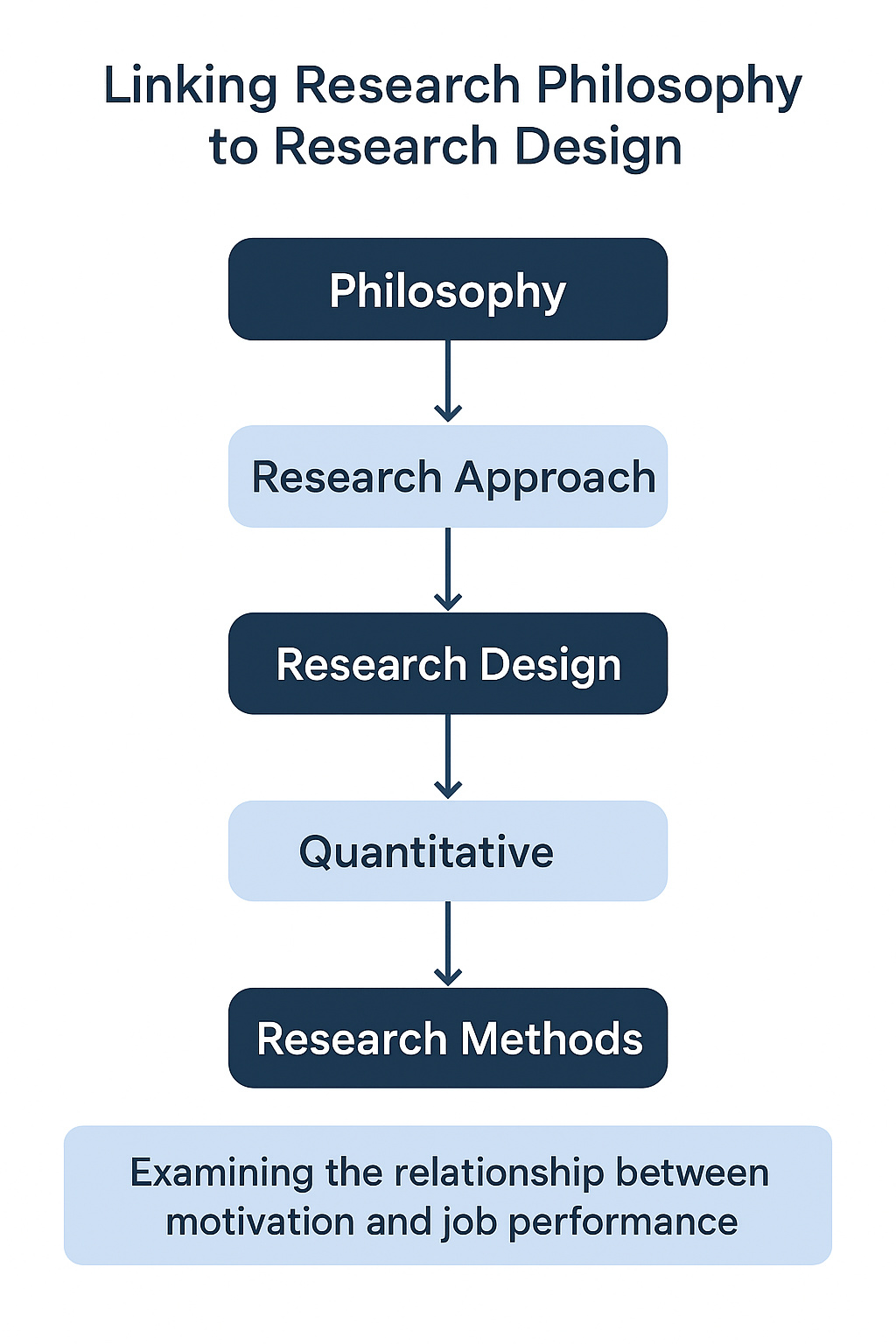
The relationship between research philosophy and design can best be understood as a sequential and logical alignment between how researchers view reality and how they choose to study it. A chosen philosophy dictates the kind of questions asked, the approach to gathering evidence, and the way results are interpreted.
For instance, positivism assumes that reality is objective and measurable; therefore, researchers under this philosophy typically adopt structured quantitative designs such as correlational and experimental studies to test hypotheses using numerical data.
In contrast, interpretivism emphasizes understanding human experiences and meanings, leading to the use of qualitative designs like case studies or phenomenology that focus on context and depth rather than measurement.
Realism bridges the two extremes by recognizing that while a real world exists independently, human understanding of it is imperfect. Consequently, realist researchers often use mixed-method designs to gain both depth and breadth of understanding. Pragmatism, on the other hand, is guided by the research problem itself rather than any fixed philosophical stance.
Pragmatists select whichever design—quantitative, qualitative, or mixed—best addresses the question and produces actionable outcomes.
In summary, philosophy informs the choice of design, and design operationalizes the philosophical stance into a workable plan. In Human Resource research, this alignment ensures that the study’s methods reflect both the researcher’s worldview and the practical realities of the HR problem under investigation.
5. Application in HR Research
Human Resource Management research deals with people and organizational behavior, requiring appropriate philosophical and methodological grounding. Examples include:
• Recruitment & Selection: Positivist approach using experimental designs to evaluate interview methods.
• Training & Development: Interpretivist approach using phenomenology to understand learning experiences.
• Performance Management: Realist approach combining surveys and interviews on fairness and performance.
• Employee Motivation: Pragmatist approach integrating surveys and interviews to explore motivation factors.
6. The Research Process Hierarchy
A coherent research structure follows this hierarchy:
Research Philosophy → Research Approach → Research Design → Research Methods → Data Collection → Data Analysis → Interpretation
This progression ensures consistency from theoretical assumptions to empirical execution.
7. Discussion
The choice of philosophy and design should be guided by the research objectives, nature of the phenomenon, and expected outcomes. In HR research, positivism dominates in quantitative performance studies, interpretivism is prevalent in employee experience research, and pragmatism is increasingly favored for solving practical HR problems.
8. Conclusion
Research philosophy provides the worldview that guides inquiry, while research design offers the strategy for implementing it. Together, they form the foundation of credible, systematic, and meaningful HR research. When well-aligned, they enhance the rigor, relevance, and practical utility of findings for policy and organizational decision-making.
References
• Saunders, M., Lewis, P., & Thornhill, A. (2019). Research Methods for Business Students (8th ed.). Pearson Education.
• Creswell, J. W., & Creswell, J. D. (2018). Research Design: Qualitative, Quantitative, and Mixed Methods Approaches (5th ed.). Sage Publications.
• Bryman, A. (2016). Social Research Methods (5th ed.). Oxford University Press.
• Sekaran, U., & Bougie, R. (2016). Research Methods for Business: A Skill-Building Approach (7th ed.). Wiley.
• Chegenye, J., Mukanzi, C., & Miroga, J. (2021). Influence of Informational Justice on Organizational Citizenship Behaviour of Public Servants in Kenya. International Journal of Humanities and Social Studies, 9(4), 75–95.
 ChegzMad Consultancy
Leave a comment