

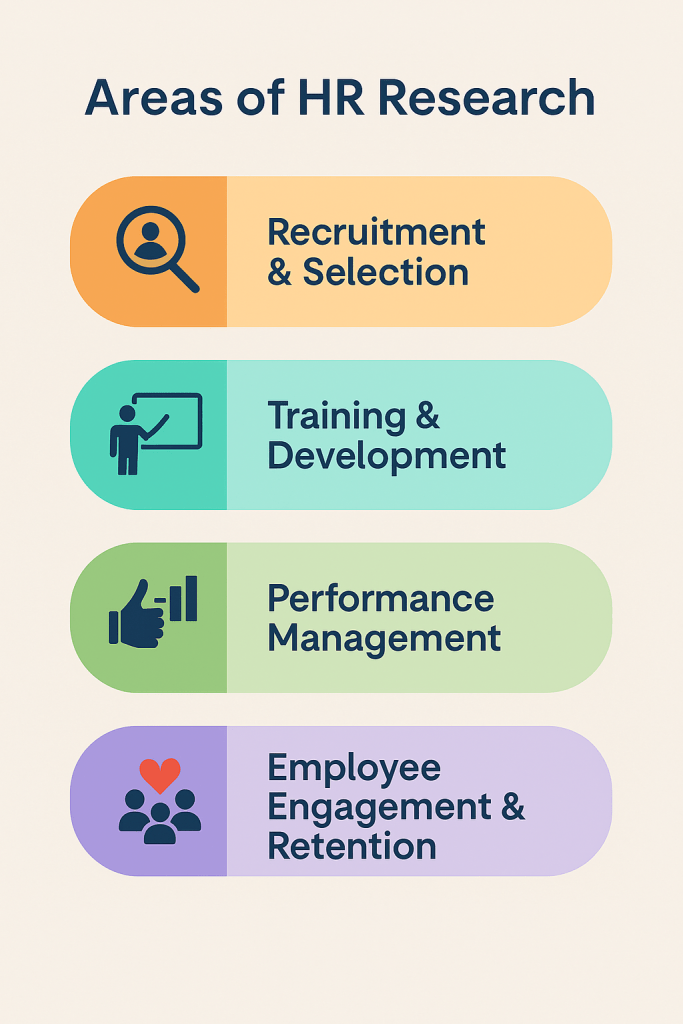
Human Resource Management (HRM) encompasses a range of practices designed to optimize the performance and well-being of employees within organizations. These practices are dependent on data for their effectiveness. To make the much needed data available research in HR is required. HR research stands out as the foundational practice that performs the function. HR as a practice provides the empirical backbone for strategic decision-making, policy formulation, and organizational transformation.
What is HR Research?
HR research refers to the systematic investigation of issues related to human resource practices, behaviors, and outcomes within organizations. It is a core practice in Human Resource Management (HRM). It enables professionals to make informed decisions based on data, trends, and evidence. This approach relies on evidence rather than assumptions or tradition. HR research transforms intuition into insight, and experience into evidence.
Human Resource (HR) research plays a pivotal role in shaping organizational effectiveness, employee engagement, and policy development. As organizations navigate dynamic environments, HR research provides evidence-based insights that inform strategic decisions, foster innovation, and enhance workforce resilience.
At its core, HR research investigates how people interact within organizational systems. It encompasses areas such as talent acquisition, performance management, labor relations, organizational behavior, and employee well-being.
Moreover, HR research supports the development of inclusive policies that promote diversity, equity, and social-emotional learning (SEL). By grounding interventions in empirical data, HR professionals can advocate for practices that meet legal frameworks. These practices also nurture holistic growth.
Objectives of HR Research
The key objectives of HR Research can be summarized as:
– To identify and solve HR-related problems (e.g., turnover, low engagement, training gaps)
– To evaluate the effectiveness of HR policies and programs
– To forecast future HR needs and trends
– To support strategic planning and organizational development
– To contribute to academic knowledge and professional practice
The Scope of HR Research
HR research spans a wide range of topics, including:
1). Recruitment & Selection
Here it looks at candidate sourcing strategies, and bias in hiring
2). Training & Development
It can investigates the impact of training on performance, and learning retention
3). Performance Management
HR research can look into Appraisal systems, and goal-setting effectiveness
4). Employee Engagement & Retention
Research can be conducted on the drivers of motivation, or turnover analysis
4). Compensation & Benefits
Research can be undertaken on Pay equity, and incentive structures
5). Labor Relations & Compliance
HR can study Union dynamics, and the legal compliance in HR policies
6). Organizational Behavior
HR research can be undertaken on Leadership styles and workplace culture
What’s The Importance of HR Research in HRM
HR research is not an isolated academic exercise. it is embedded in every strategic HRM function. Its importance includes:
– it enables evidence-based Decision-Making. Through this it is able to replace guesswork with data-driven insights
– it enhances strategic alignment by ensuring that HR practices support organizational goals
– it leads to continuous improvement by Identifying gaps and refining HR interventions
– it can contribute to risk mitigation as it enables the anticipation of legal, ethical, and operational risks
– it develops strong customization by enabling the designing of HR solutions tailored to specific contexts and populations
Types of HR Research.
HR research can be categorized into:
1). Basic Research
Basic research aims to ecplore fundamental HR concepts and theories like in motivation and leadership
2). Applied Research
Applied Research is aimed to solve specific organizational problems like absenteeism or low morale.
3). Action Research
It is a collaborative, iterative inquiry aimed at real-time improvement in performance
4). Evaluative Research
This type assesses the impact of HR programs and policies
Conclusion.
HR research is the compass within HRM. It guides organizations toward data-informed, people-centered transformation.
HR research is not merely academic. it is a strategic tool for shaping the future of work, leadership, and human development.
 ChegzMad Consultancy
Leave a comment