

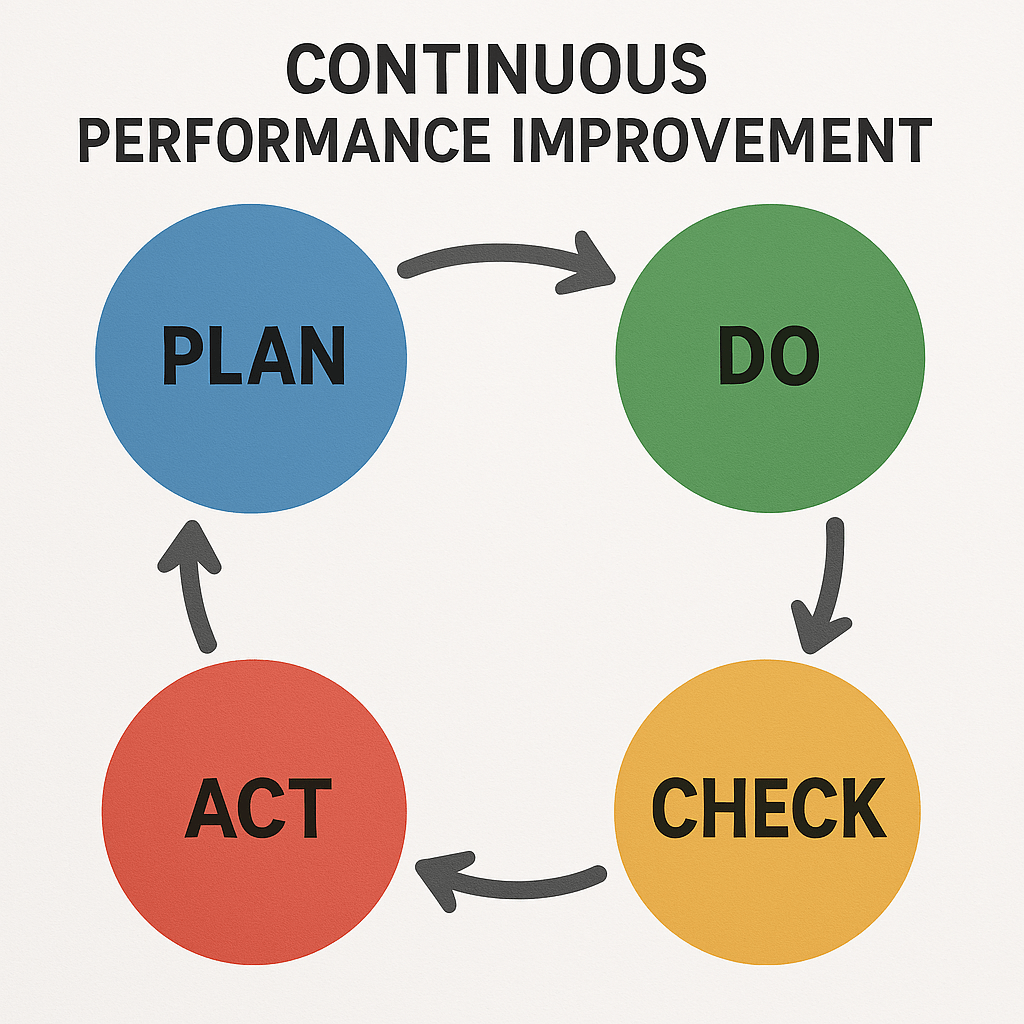
Performance improvement is one of the steps in the performance management process.
Aguinis (2019) defines performance improvement as part of a structured performance management process that aligns individual efforts with organizational goals. Deming (2018) highlights continuous improvement as a cultural and systemic approach to achieving long-term performance gains.
Goetsch and Davis (2021) explains continuous improvement as a philosophy like Kaizen or PDCA that underpins sustainable performance improvement.
Oakland (2019) while linking continuous improvement to performance outcomes, acknowledge that lasting performance improvement requires embedding continuous improvement practices.
Jentsch (2012) shows how performance improvement relies on continuous learning and feedback loops.
Institutionalizing Performance improvement
Institutionalizing Performance improvement means embedding it into the culture, systems, and daily practices of an organization. This ensures it becomes a continuous process, rather than a one-time initiative.
Scott (2014) defines institutionalization as the process by which certain practices or rules become widely accepted. These rules are then taken for granted. They become embedded in organizational and social systems.
Institutionalization means making a practice, policy, or system, an established and permanent part of an organization, culture, or society.
It goes beyond just starting or implementing something. it ensures that the new practice becomes: part of daily routines and culture. The process is standardized through policies, rules, or procedures, and is sustained over time, regardless of leadership or staff changes.
Systematic Institutionalization of Continuous Improvement
Institutionalization can take place through these steps
1. Leadership Commitment and Vision
Leadership commitment is critical. They need to:
• Champion performance improvement by clearly communicating its importance and modeling desired behaviors.
• Align improvement goals with the organization’s strategic plan so that staff see a clear connection.
2. Set up a Performance Management System (PMS).
A performance management system needs to be created. This can be done by:
• Developing policies and frameworks that define performance standards, expectations, and evaluation processes.
• Linking individual, team, and organizational performance goals.
• Ensuring feedback loops and regular reviews are part of the framework.
3. Build a Culture of Continuous Learning
Continuous learning is key.
• Encourage open communication and knowledge sharing.
• Provide opportunities for capacity building, training, and professional development.
• Normalize constructive feedback as a tool for growth rather than punishment.
4. Use Data and Evidence
• Institutionalize data-driven decision-making by collecting and analyzing performance indicators.
• Establish Key Performance Indicators (KPIs) and performance dashboards.
• Promote accountability by making results transparent.
5. Employee Involvement and Ownership
• Engage employees in goal-setting and problem-solving.
• Reward and recognize performance improvements to reinforce positive behavior.
• Create cross-functional teams to foster collaboration in solving performance challenges.
6. Standardize Processes and Best Practices
• Document and share standard operating procedures (SOPs) and success models.
• Institutionalize regular performance review meetings at all levels.
• Establish continuous quality improvement cycles like Plan, Do, Check, and Act(PDCA)
7. Give Incentives and Motivation
• Align performance with rewards, promotions, and career development.
• Balance monetary incentives with recognition programs like award of certificates, awards and public acknowledgment.
8. Put in place Governance and Accountability Structures
• Create committees, units, or focal points responsible for driving performance improvement.
• Define roles and responsibilities at all levels to ensure accountability.
• Integrate performance improvement into annual reviews, audits, and reporting systems.
9. Conduct Continuous Monitoring and Evaluation
• Establish mechanisms to track progress, identify gaps, and adjust strategies.
• Institutionalization where successes and failures are analyzed.
Conclusion
To institutionalize performance improvement, organizations must embed it into leadership, culture, systems, data practices, and accountability structures. This ensures it is not a project with an end date, but a permanent organizational norm.
 ChegzMad Consultancy
Leave a comment